As an Amazon Associate I earn from qualifying purchases.
Short answer: a pair of New Balance with real arch support, and budget at least $150.
That’s what I’d tell a new nurse with no foot problems yet. The reason for “yet” is the point of this whole article.
I’ve been nursing for over thirty years. I have severe bunions, heel spurs, and legs covered in spider and varicose veins. Some of that is unavoidable in this job. Some of it is shoes.
Buy arch support before you need it
If your feet don’t hurt, it’s tempting to buy whatever’s comfortable in the store and move on.
Get real arch support anyway. Foot problems in nursing build up over years, and by the time you have symptoms you’re managing a problem instead of preventing one. The shoes you wear in your twenties are still with you in your fifties.
My picks, in order:
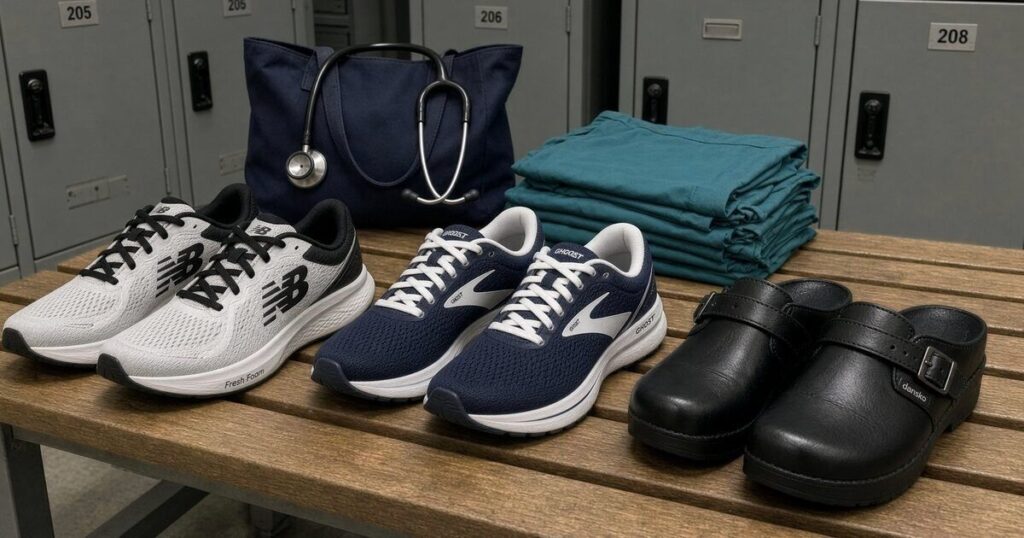
- New Balance — the safest go-to. Good arch support out of the box, available in wide sizes, and they hold up.
- Brooks — my second choice. Comfortable, though I’ve had durability problems with one pair.
On Hokas: I don’t hate them. I spent $200 on a pair and wasn’t impressed for the price. Plenty of nurses love them, so this is a fit preference rather than a product flaw — just don’t assume the expensive option is automatically the right one.
Budget at least $150
I’m usually in favor of being frugal. This is the exception.
Quality matters more than price here, and below about $150 you’re generally not getting the support and construction that holds up to twelve-hour shifts on hard floors.
That said, more expensive isn’t automatically better. My $200 Hokas didn’t work for me and my current Brooks were on clearance.
Buy two pairs and rotate them
This is the recommendation I’d push hardest, and most nurses don’t do it.
Own two pairs of work shoes and alternate — wear one pair for a day or two, then switch.
Giving shoes a day off lets the midsole foam decompress and the shoe dry out fully between wears. Both extend the life of the shoe and keep the cushioning working.
Work shoes should be work shoes. If you run or work out, those shoes aren’t part of the rotation. They have their own wear pattern and their own mileage.
If you’re dealing with foot pain, there’s a second version of this: take your backup pair to work and change halfway through the shift. It helps, and I can’t fully explain why.
Replace them every six months
Six months is the outside limit, or sooner if your feet start hurting.
Shoes break down fast when you’re on your feet that much, and the failure is usually invisible. The midsole compresses permanently, so the shoe looks fine while the part doing the actual work has quit.
If your feet have started hurting and nothing else changed, look at your shoes before you blame your feet.
Liquid resistance actually matters
This is the healthcare-specific part nobody covers in a shoe roundup.
You should be wearing leather or liquid-resistant shoes in a clinical setting. Fluid-resistant footwear is recommended precisely because blood and other fluids end up on your shoes more often than you’d like, and a porous upper lets it soak in.
I’ll be honest: most of my shoes are canvas-type uppers, so I’m not following my own advice here. But if you’re buying fresh, leather or a liquid-resistant upper is the safer choice.
What I do instead: I spray new shoes with a water-repellent protector. The one I use is called Crep. It’s the same idea as Scotchgard — right when I get them, and let them dry before wearing. It stops blood and fluids soaking into the material, which makes everything easier to clean and keeps them from staining.
If you’re going the canvas route, do this on day one. It’s much easier than trying to save a shoe afterward.
How to clean them
I wash mine all the time, and they survive it:
Washing machine. My canvas-type shoes go in the washer. Air dry afterward — heat from a dryer is hard on adhesives and midsoles.
Magic Eraser for leather parts. Works well on scuffs and marks on the leather sections.
For blood: Shout. Spray it on and it washes right out, especially if the shoe has been treated with a protector.
Peroxide also works, with a caution. Test it somewhere hidden first. It bleaches some materials, and you’ll only find that out after it’s visible.
Clean them regularly rather than when they’re filthy. It’s a lot less work and the shoes last longer.
What to skip
Danskos. 100%. They’re popular in nursing and they’re the worst thing I’ve worn. There’s a heel, there’s not enough padding, and I feel like I’m constantly curling my toes to keep them on.
Clogs in general, for the same reasons.
Anything flat — Converse or similar. No arch support, no cushioning, and they’ll wreck your feet on a hospital floor.
Anything with a heel rise, even a small one.
Shop before you need them
The best buying advice I have: keep an eye out all the time, not when you need shoes.
I got my current Brooks on clearance because I happened to be looking when they were marked down. If you wait until your current pair is dead, you’re buying in a hurry at full price and taking whatever’s in stock in your size.
Since you should own two pairs anyway, having a spare in the closet isn’t waste — it’s the rotation.
The short version
- New Balance as the default. Brooks as the backup.
- Budget $150+, but don’t assume pricier is better.
- Two pairs, alternating days.
- Replace every six months or when your feet start complaining.
- Liquid-resistant uppers, or spray canvas ones with a protector on day one.
- Wash them regularly. Shout for blood, Magic Eraser for leather, air dry.
- No Danskos, no clogs, nothing flat.
- Buy on sale before you need them.
If you have specific foot problems — plantar fasciitis, wide feet, or you’re standing on concrete all shift — those need their own approach, and I’ve written about each separately.