
As an Amazon Associate I earn from qualifying purchases.
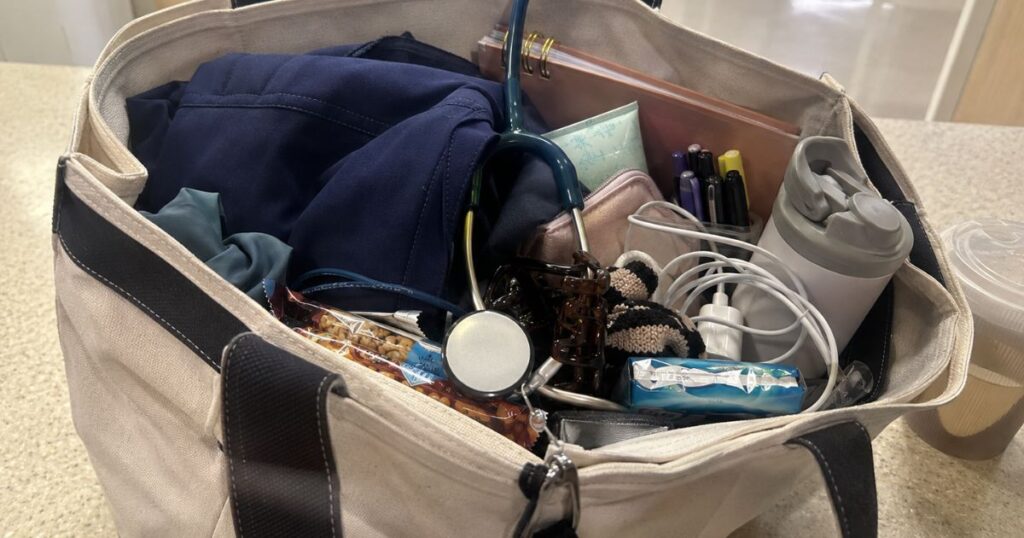
Every “what’s in my nurse bag” list I’ve seen looks like it was packed for a photo shoot. Everything color-coordinated, every item earning its place.
Here’s mine, after thirty years of nursing. Then here’s what actually matters.
An honest inventory
Right now my work bag is a very large purse. Currently inside it:
- My wallet and my name badge
- Roughly a million pens, plus markers
- Three box cutters (I open a lot of boxes at work, but three is still a lot)
- Phone chargers, plural, and a power bank
- An Apple Watch I never wear
- Hand sanitizer and lotion
- Cough drops and Advil
- A planner I don’t use
- A layer of sticky notes and scraps of paper at the bottom with important things written on them, which I will never find again
This is what a nurse bag looks like after a few years without supervision. If yours is similar, you’re in good company.
The four things I’d never leave home without
Strip everything else away and this is the list:
- A phone charger. Your phone is your clock, your calculator, your contact list, and your lifeline to the outside world for twelve hours. A dead phone at hour six is miserable.
- A pain reliever. Advil, in my case. Twelve hours on your feet produces headaches and aches, and the one day you don’t have it is the day you need it.
- Pens that work. Blue ink, several of them. They will walk away. Other people will borrow them and not return them. Carry backups.
- Caffeine. My version is a Celsius. Yours might be coffee or something else. Know what gets you through hour ten.
Plus two small ones that punch above their weight:
- Hair ties. You will need one, and nobody at work will have a spare.
- A good coffee cup. I bring mine every shift and keep sweetener and creamer in the work fridge rather than hauling it back and forth.
That’s genuinely most of it.
Stop carrying what work already has
This is the biggest lesson, and it took me years.
When I worked in the hospital, I thought I had to carry everything I might possibly need during a shift. Sharpies, tape, sticky notes, highlighters, office supplies of every kind — all in my bag, every shift.
Almost all of it was already available at work. Supply rooms exist. Nurses’ stations are stocked. I was hauling a second office to and from my car every day for no reason.
Before you add something to your bag, ask: is this already at work? If yes, leave it there.
Same logic with the stethoscope. I leave mine at work. It’s one less thing to forget, one less thing to carry, and it’s always where I need it. If your workplace has a secure spot for it, do the same.
Pockets vs. bag
My rule is simple: pens in pockets, everything else stays at the station.
Pockets get heavy fast, and scrub pockets are not designed for weight. Carry what you reach for constantly. Everything else lives in your bag or at your desk and you walk to it.
Food
I’ve gone back and forth on the lunch box.
These days I don’t pack a lunch — I snack through the shift, and my current workplace keeps the break room stocked. That’s a luxury, not a strategy, and plenty of units don’t have it.
What I’d actually recommend: keep a few protein bars or shelf-stable snacks in your bag at all times. The shifts where you don’t get a real break are exactly the shifts you can’t predict. Something in your bag beats nothing.
My weakness is replacing them. I’ll carry protein bars until I run out, then go weeks before I remember to buy more. If you’re the same, buy a box and keep it in the car.
Night shift changes the bag
More snacks. Night shift runs on grazing. Pack more than you think.
And watch for the other night shift problem: the bag becomes a holding area for your whole life. I’d throw things in for errands I planned to run on the way home — paying bills, the grocery store, the gym — and then drive straight home and sleep. The stuff stays in the bag. Next shift it’s still there. Before long you’re carrying a week’s worth of good intentions.
Empty the errand stuff after every shift. If you didn’t do it this morning, it doesn’t need to ride to work with you tonight.
Choosing the bag itself
I’ve tried everything: totes, backpacks, lunch-bag combos, and now an oversized purse.
Backpacks are the most comfortable to carry and the easiest on your back. My problem with them is that the extra space gets filled with junk. More room means more stuff, not more organization. I recently got this one, and I love it!
A tote or big purse is easier to dig through but hard on one shoulder.
Honestly, the bag matters less than how often you clean it out. Whatever you choose, look for:
- Separate compartments or pouches, so small things don’t sink to the bottom
- A place for your drink that won’t leak onto everything else
- Something wipeable. It’s going to sit on hospital floors.
If your bag has one big open cavity like mine, a few zip pouches inside make a real difference. Chargers in one, meds and hair ties in another, pens in a third.
The planner problem
I carry a planner. I’ve always carried a planner. I use it enthusiastically for about a week, then it sits in the bottom of my bag adding weight until I buy a new one.
If that’s you too: either commit to it or take it out. A planner you don’t use is just a book you carry to work.
The short version
Always carry: phone charger, pain reliever, working pens, caffeine, hair ties, a snack.
Leave at work: supplies work already provides, and your stethoscope if you can store it securely.
Clean it out every week, because the bag will fill itself with sticky notes, errands, and planners if you let it.
Mine obviously needs to take its own advice.